Authentication
ROADMAP.md 0.16.0 — legendarr is a single-tenant, self-hosted app: one shared admin login, not a multi-user system, off by default so existing installs and a trusted LAN deployment are unaffected until an admin opts in from Settings.
Enabling login
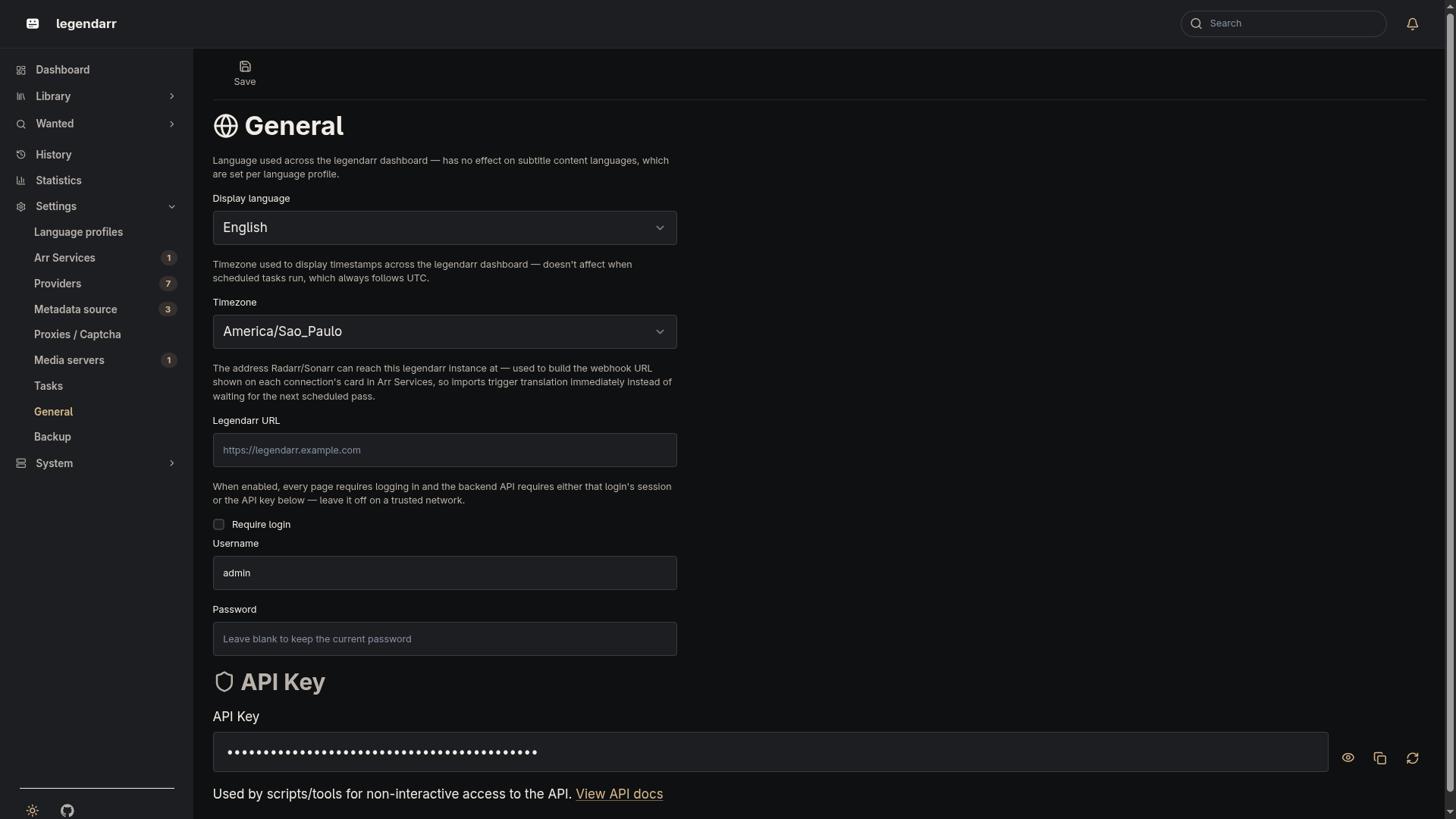
Settings → General (/settings/general/) has one toggle — "Require login" — plus a username and password. Enabling it requires both to already be set or provided in the same save; manage_authentication.update_auth_settings rejects an enabled=True update that would leave the account without a resolvable username and password, since that would lock every login out with no way back short of editing config.yaml by hand. The password is hashed with PBKDF2-HMAC-SHA256 (authentication/passwords.py, stdlib hashlib, no extra dependency) before being stored in config.yaml — never in plaintext, and never re-displayed once saved.
What gets gated
Two independent layers, both driven by the same auth_enabled flag:
- The web UI. A single FastAPI dependency (
legendarr_web.authentication.session_guard .require_authenticated_session) is registered once, app-wide, inlegendarr_web/app.py— it applies to every included router automatically, so a new page never needs to remember to add it. An unauthenticated visitor is redirected to/login(a303for a normal page load, anHX-Redirectfor an HTMX request, so a partial swap doesn't render a login form inside a content div)./loginand/logoutare the only exempt paths. - The backend API. A second app-wide dependency (
legendarr_backend.authentication.api_guard.require_api_access) gateslegendarr_backend'sapi_app. A request is allowed if it carries either a validX-Api-Keyheader (for scripts — the same key shown in Settings, see the External API) or a validX-Legendarr-Sessionheader (forwarded automatically bylegendarr_web'sget_backend_clienton every call, so a logged-in browser session authorizes the backend calls made on its behalf without a second shared secret between the two processes)./webhooks/*is exempt — Radarr/Sonarr's "Connect" calls can't send any header, the same unauthenticated-by-design contract documented onmedia_library/webhooks.py's own route — along with/auth/login,/auth/logout, and/auth/sessions/validate, the bootstrap trio a caller can't already hold credentials to reach.
Sessions
A successful login creates an AuthSession row and hands the browser an opaque token in an HttpOnly cookie (legendarr_session). Only a SHA-256 hash of that token is persisted — never the raw value. A session slides forward 30 days from its last use each time /auth/sessions/validate runs (once per page navigation); it's fixed, not configurable from Settings.
System → Sessions (/system/sessions/) lists every active session — device, IP address, login time, last-seen time — flags the viewer's own session as "This device", and can revoke any other session individually or all of them at once.
API key
Settings → General also shows a generated API key (secrets.token_urlsafe(32)), stored encrypted at rest the same way as radarr_api_key/sonarr_api_key (security/fernet.py), masked by default with a reveal toggle and a copy button since it's a credential the admin needs to retrieve, not one they chose. "Regenerate" invalidates the old key immediately. It's the credential for the External API (ROADMAP.md 0.17.0) — the intended non-interactive surface for it.